
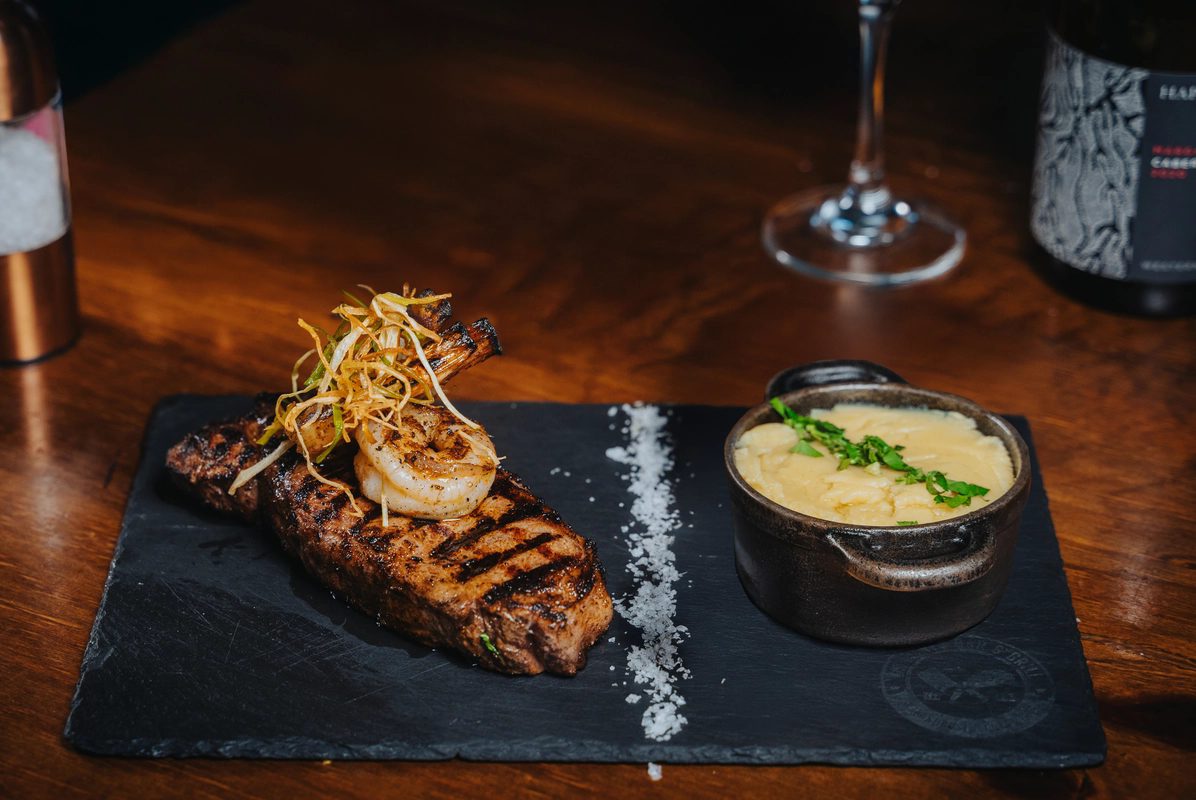

Steak or seafood is the wrong argument to have at a steakhouse table. Surf and turf in Sydney settles it by putting both on the one plate. Plenty of Australians still order it under the older local name, reef and beef.
Most people order it on instinct, though, and end up with a rich cut wrestling an equally rich sauce. Here is what the dish actually is, and which steak to pair with which seafood. Portion sizes follow, along with the $59 Surf 'n' Turf Night that runs every Monday and Sunday in Belmore.
What Is Surf and Turf, and Why Is It Called Reef and Beef?
Surf and turf is a main course that puts seafood and red meat on the same plate. The surf is usually prawns, squid, scallops or lobster. The turf is a beef steak. In Australia the same dish often appears as reef and beef, and it belongs on steakhouse menus rather than seafood ones.
The name carries two competing origin stories. One credits the 1962 World's Fair in Seattle. The other points to a 1966 newspaper advertisement for a Massachusetts restaurant. Either way, by the 1970s the dish stood for accessible continental dining rather than fine dining.
That reputation stuck for decades. It has shifted again more recently, because kitchens stopped treating the seafood as a garnish.
Which Steak Cut to Pair With Which Seafood
Pairing is where most tables go wrong. The instinct is to order the biggest cut alongside the most expensive seafood. That leaves two rich things competing for the same space on your palate. Balance beats volume here, every time.
Work in the other direction instead. Choose the seafood first, then pick a cut with the fat content to match it. If you want a longer read on the cuts themselves, our guide to choosing the best steak cut covers each one in detail.
| Seafood | Steak cut | Why the pairing works |
|---|---|---|
| Four chargrilled prawns | Sirloin 300g | Prawns are sweet and lean. A sirloin brings real beef flavour without swamping them. |
| Whole grilled squid | Scotch fillet 300g | Squid carries char and a firm bite. Extra marbling in the scotch fillet softens that contrast. |
| Broiled whole lobster | Eye fillet 250g | Lobster is the rich half of this plate, so keep the beef lean and let the butter do the work. |
| Four chargrilled prawns | MB9 wagyu rump 300g | At marble score 9 the beef is already doing plenty. Prawns hold the balance; lobster would fight it. |
Marble score is the number worth understanding before you commit. AUS-MEAT grades run from 0 to 9, based on how much intramuscular fat sits in the eye muscle. Meat and Livestock Australia sets out how that assessment works. A higher score means a richer mouthful, which is precisely why it should change the seafood sitting beside it.
The Sauce Decision That Makes or Breaks the Plate
Sauce is the part nobody plans and plenty of people regret. A cream sauce over a heavily marbled cut, next to seafood finished in butter, stacks three fats into one mouthful. All three flatten out.
At Elements Brasserie the surf 'n' turf additions arrive with mushroom sauce, which suits a leaner cut nicely. Order something richer and the signature sauce list gives you better moves. Black garlic aioli cuts cleanly through prawns. Romesco was built for grilled squid. Native pepperberry sauce lifts almost anything off the grill without adding another layer of cream.
One sauce per plate is usually enough. Two turns dinner into a tasting exercise, and the seafood is always the thing that gets lost.
How Much Surf and Turf to Order Per Person
Portioning gets simple once you stop guessing. A 300g steak with four chargrilled prawns is a complete main for one adult. The prime cuts already come with a side. You choose between tallow pom puree, steakhouse chips or a garden salad, rather than ordering more food on top.
Lobster changes the maths. A 600g broiled whole lobster reads as a plate for two. Pair it with one larger cut and share it. It also works dropped into the middle of a table already ordering steaks.
Feeding a bigger group? The steak tasting platter puts a spread of cuts on one board, and seafood can go alongside it.
Surf 'n' Turf Night: $59 Every Monday and Sunday
The simplest way to eat surf and turf in Belmore is the night the kitchen has already built the plate for you. Surf 'n' Turf Night runs every Monday and Sunday at $59 per person. A sirloin steak, parmesan mascarpone potato puree, and two chargrilled prawns cooked to order.
It is the same sirloin off the same grill as any other night, and the same prawns. Only the price changes. That is what makes it the best-value version of this dish on the menu, and it is why those two nights book out first.
A few conditions are worth knowing before you arrive. Claim the voucher, then mention it to your waiter before you order, because it cannot be applied to the bill afterwards. The offer is dine-in only and capped at six guests per table, so larger groups need approval in advance. It does not run on special occasion dates, and a 15 per cent public holiday surcharge applies. Prices are current at time of writing.
Building Your Own Plate at Elements Brasserie
Any other night, you build it yourself. The surf 'n' turf additions sit beside the Butcher's Prime Cuts on the lunch and dinner menu: four chargrilled prawns at $19 or a whole grilled squid at $22. Add either to the cut you have chosen; both come with mushroom sauce.
The restaurant sits on Canterbury Road in Belmore, minutes from Campsie, Canterbury and Roselands, with easy parking and dog-friendly outdoor seating. Mention any dietary requirements when you book so the kitchen can talk you through the options.
Surf and Turf FAQs
What is the best steak for surf and turf?
It depends on the seafood. Lean, delicate seafood such as prawns pairs well with a sirloin, because the beef carries the flavour. Rich seafood such as lobster works better against a lean eye fillet. With a heavily marbled cut like a wagyu rump, keep the seafood light. Both halves of the plate then stay in balance.
Why is surf and turf called reef and beef in Australia?
Both names describe the same idea, which is land meat served with seafood. Surf and turf came out of American restaurants in the 1960s. Reef and beef is the Australian version of the rhyme, and it still appears on pub and steakhouse menus around the country.
How much does surf and turf cost in Sydney?
The range is wide, because you are paying for two things at once. Adding prawns or squid to a steak is a modest step up, around $18 to $22 at Elements Brasserie. Adding a whole lobster is a significant one. Set offers usually come in lower, since the venue has chosen the cut and the portion. Surf 'n' Turf Night sits at $59 per person at time of writing.
Can you order surf and turf with squid instead of prawns?
Yes, and it is underrated. Grilled squid brings char and a firmer bite, so it holds its own against a fattier cut in a way prawns cannot. Squid alongside a scotch fillet gives you more contrast than the standard prawn pairing.
When is Surf 'n' Turf Night at Elements Brasserie?
Every Monday and Sunday. The plate is a sirloin steak with parmesan mascarpone potato puree and two chargrilled prawns, at $59 per person. Claim the voucher before you arrive and tell your waiter about it before ordering. It is dine-in only, capped at six guests per table, and it does not run on special occasion dates.
Is surf and turf a starter or a main?
It is a main. The dish was built as a full plate, with the seafood part of the main course rather than served ahead of it. Some kitchens offer smaller entree versions. At a steakhouse, expect it as the centre of the meal.
Book a Table at Elements Brasserie
Every cut is grilled to order, and the seafood is held to the same standard. The pairing becomes a real decision rather than a garnish stapled to a steak.
For the $59 plate, book a Monday or a Sunday. Head to the booking page or call 1300 ELEMENTS (1300 353 636).